
How its done
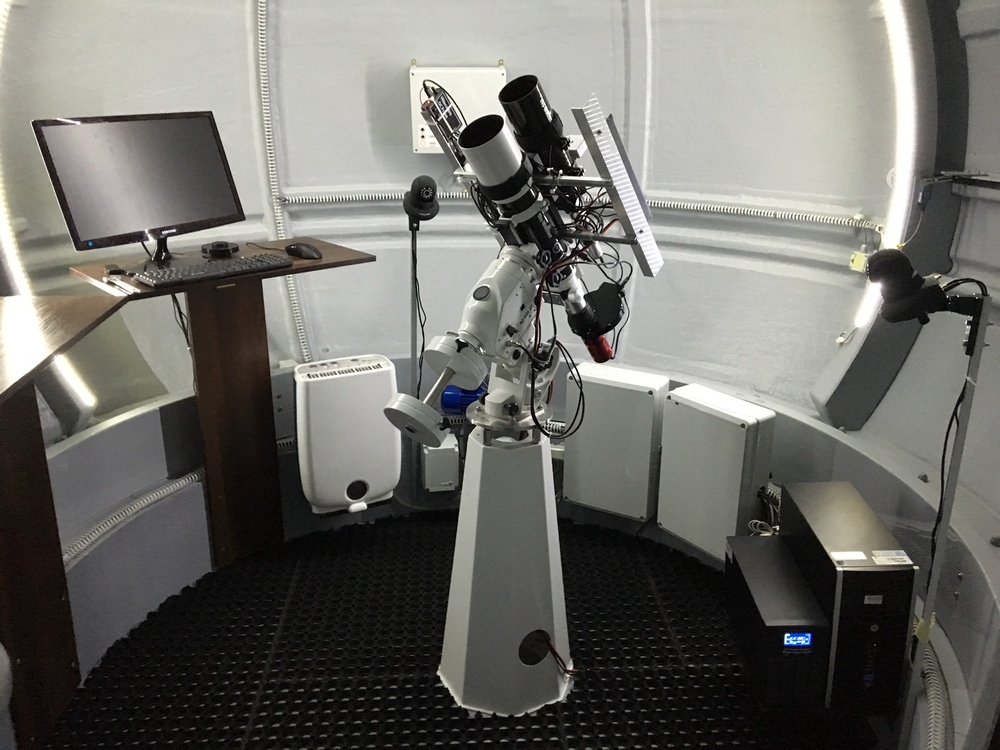
It has taken me 10 years to put together the catalogue of pictures you see. Without a permanent observatory – located far outside any city or light pollution – these pictures would have not been possible. All images require a clear sky, and most images also a moon-less night. Those rare nights cannot be missed, and the amount of exposure time required for a single picture is substantial, sometimes spanning over multiple years until there is enough clean data available to process into a final image. Not only is a clear sky required, preferably without or just a small slice of the moon, but the target needs to reach a certain elevation in the sky, which changes from month to month. Combining all these factors makes Astrophotography a hobby requiring a decent amount of patience and a sprinkle of madness.
My observatory is fully remote operable and lets me image no matter where I am in the world. Due to the fact that it is also fully automated, I do not have to stay up all night to tell the telescope, camera and all other equipment what to do, and when. This part of the challenge is not to be underestimated. Getting many physical components to work well together and having their appropriate software and drivers work seamlessly, has caused more grey hair than old age.
And when you have gotten everything perfectly in sync, random issues like (finally identified as) a spider walking over the home sensor of your observatory, causing it to completely loose its proper positioning information, will always keep you busy in some way.
In contrast to daytime imaging, where your exposure time will be measured in milliseconds, most of the images were composed of 20 minute exposures. Thats right, 20 minutes where the telescope may not move more than a few micrometers in the wrong direction. And you need many of them per wavelength spectrum (or colour) you are shooting, resulting in a final image requiring anywhere between 5 and 120 hours of imaging time, depending on the brightness and size of the target. If any unexpected movement happens, or a cable was preventing a smooth movement, that frame will be useless.
Assuming all the physical work of capturing the data required for a final image has been successful, hours of processing the data in specialised software begins. And due to the infinite possibilities in getting the final result as perfect as possible it sometimes took me years to get to a picture I was content with.
Did i ever capture anything out of the ordinary? Except from airplanes flying through my long exposures, and recently hundreds of satellites making the lives of astrophotographers a nightmare, I did once capture a ‘moving’ star which however turned out to be an already discovered asteroid, and therefore I was unable to name it. So far, no Extraterrestrials.